



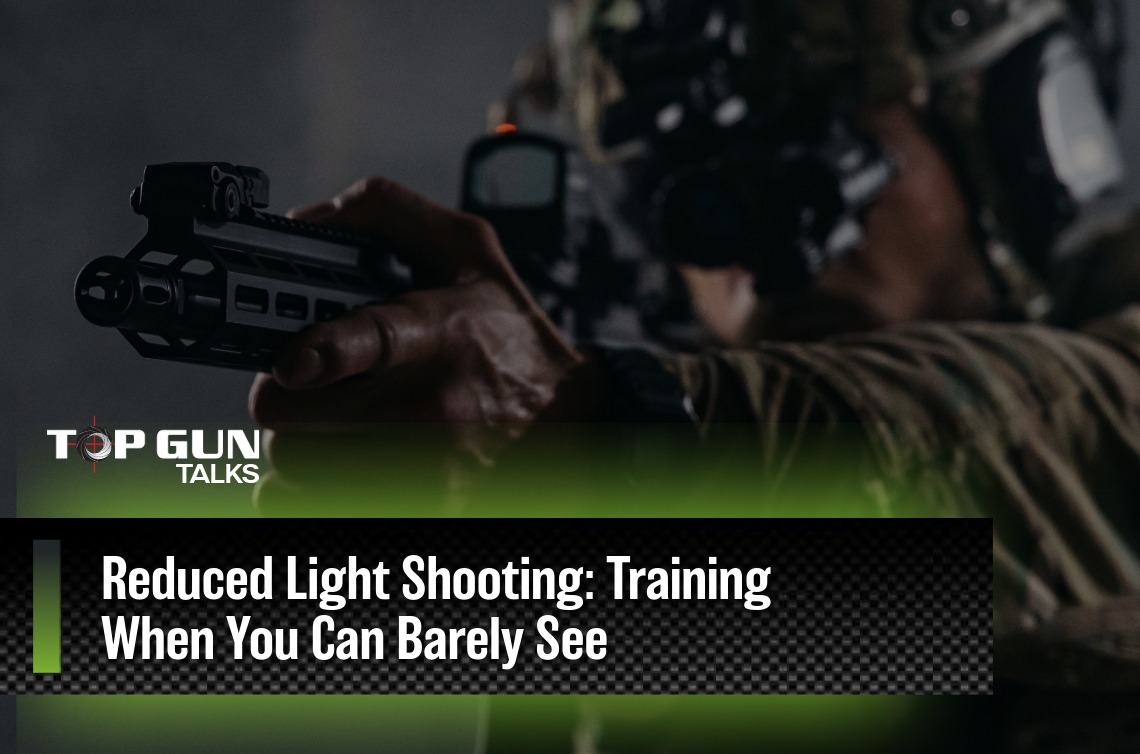
A clean, brightly lit shooting range gives you something a real defensive encounter may not: a clear view of what is in front of you.
Outside the range, visibility can change quickly. Parking lots get darker after sunset. Hallways may only have light coming from another room. Shadows can hide important details. Even when there is enough light to see a person, there may not be enough light to immediately understand what they are doing.
That is where reduced light shooting becomes less about simply hitting a target and more about making the right decision.
Low light pistol training is built around a simple principle: before you can make a good shooting decision, you need enough information to know what you are looking at.
Reduced Light Changes the Decision Before the Shot
Poor visibility creates uncertainty. You might see movement without clearly seeing someone’s hands, or recognize a person without knowing what they’re holding. Shadows, distance, objects, and changing light can all distort what you see.
Responsible armed self-defense should never rely on guesswork. That’s why low-light training should help you better recognize when a threat requires action and when it doesn’t.
It’s the same approach we use when teaching students to recognize when a threat is developing, when it can still be avoided, and when defensive action becomes necessary.
Why Daylight Range Practice Leaves a Gap
Traditional range practice has an important purpose. It helps develop firearm safety, gun handling, accuracy, and familiarity with your equipment.
But a paper target in good lighting does not make decisions.
It does not move from shadow into light. It does not force you to determine whether something in a person’s hand is dangerous, and it does not test whether you can slow yourself down when you are uncertain.
Stress can also change perception. Vision may narrow, time can feel distorted, and the brain may struggle to process everything happening at once. Training on the psychological side of armed defense examines how stress can affect vision, memory, judgment, and the way a person interprets a fast-moving event.
When poor lighting is added to that stress, simply knowing how to shoot accurately is not enough.
A Flashlight Is a Tool, Not an Answer
A flashlight can provide information, but carrying one does not automatically make someone prepared for a reduced-light encounter.
A good flashlight pistol technique begins with safety and identification. The purpose of the light is not simply to illuminate a target. It is to help you gather information before making a decision.
Reduced-light training should reinforce several priorities:
- Identify what you are seeing.
- Avoid making decisions based only on movement or shadows.
- Maintain safe firearm handling while attention is divided.
- Recognize innocent people and objects that may be nearby.
- Know when there is not enough information to justify taking action.
These decisions require practice because attention becomes harder to manage when visibility is poor. Darkness will never become more comfortable, but your responses can become more controlled.
“Shoot / Don’t Shoot” Is a Skill of Its Own
One of the biggest differences between ordinary target practice and defensive firearms training is that the correct answer is not always to shoot.
Sometimes the right decision is to stop.
Sometimes it is to wait for more information.
Sometimes it is to disengage completely.
That’s why “shoot, don’t shoot” training is such an important part of realistic preparation. Students need opportunities to process information before deciding what action is appropriate.
This connects directly with the decision-making process referred to as the OODA loop:
Observe what is happening.
Orient to the situation.
Decide on a response.
Act.
Reduced visibility places even more pressure on the cycle because there may be less visual information available from the beginning.
Speed matters in an emergency, but speed without accurate information can create a new problem.
Darkness Changes Your Environment Too
Reduced light does more than make a target harder to see. It changes how you understand the space around you.
A doorway can look different when one room is bright and the other is dark. Shadows can conceal movement or make an ordinary object appear unfamiliar. Vehicles, walls, furniture, and other surroundings can affect what you can and cannot clearly identify.
It’s important to teach students to consider how walls, vehicles, furniture, shadows, visibility, and surrounding cover can change the way an environment is perceived.
The environment is never just a background, it’s another factor to process.
Low Light Training Should Build Restraint
One of the most important lessons in reduced-light training is knowing when you don’t have enough information.
Responsible gun owners are accountable for the decisions they make. Darkness does not remove that responsibility. If anything, limited visibility makes restraint more important.
A person who has only practiced shooting clearly visible targets may develop confidence in marksmanship without ever testing their judgment, but effective training should develop both in order to build disciplined behavior that can survive stress, confusion, and less-than-ideal conditions.
That includes recognizing when a situation can still be avoided, keeping firearm safety at the center of every decision, and understanding that the fastest response is not always the correct one.
Train for Conditions Outside the Range
As the days become shorter and evenings arrive earlier across Southern California, more of everyday life takes place after dark. Walking through a parking area, arriving home, leaving work, or simply being outside in the evening can mean operating with less visual information than you would have during the day.
Your training should account for that reality.
Low light pistol training gives experienced shooters an opportunity to test more than their accuracy. It challenges their ability to process information, maintain safe firearm handling, and make disciplined decisions when they cannot immediately see everything clearly.
Pistolcraft-140 was built for this purpose.
Visit the Top Gun Training Centre Website to schedule a Pistolcraft-140 session and take your defensive training beyond the conditions of a brightly lit range.
Stay aware. Stay disciplined. Stay ready.