



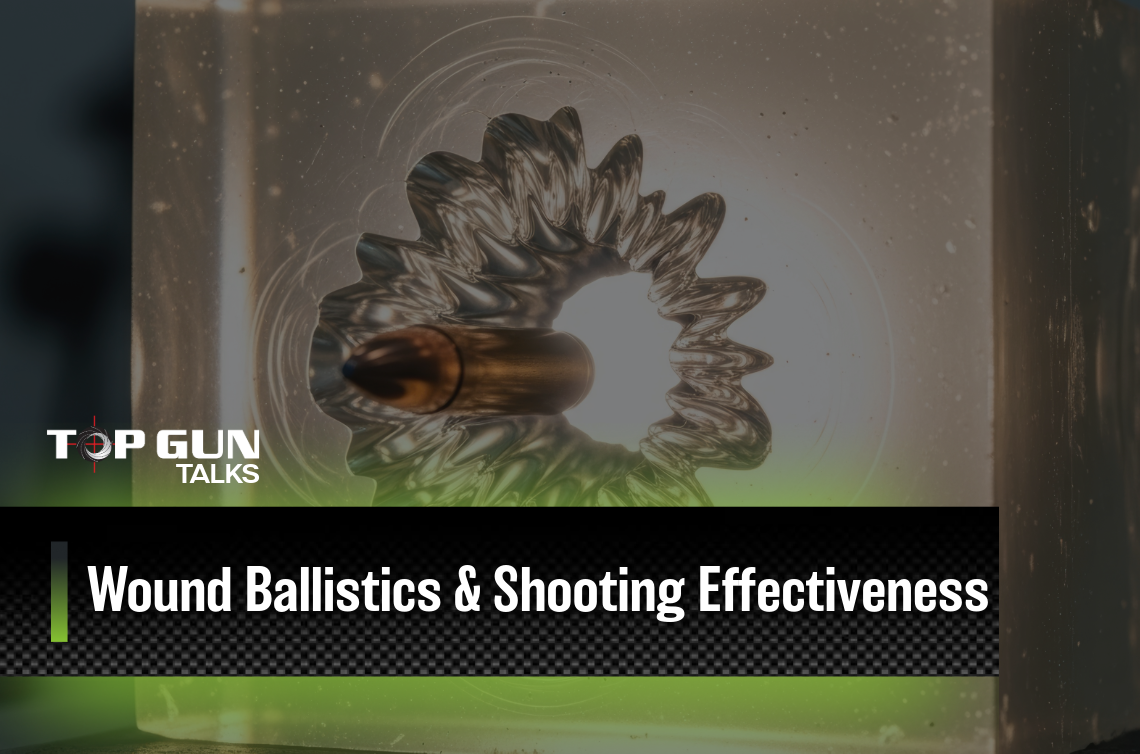
Wound Ballistics: Understanding How Bullets Behave in Real Defensive Encounters
Most force encounters don’t happen instantly. They build. If you don’t understand how to recognize a threat early, you’ll always be behind it. The use of force continuum gives you that clarity. You must understand what a bullet actually does once it leaves the barrel, how it behaves inside the body, and why certain assumptions about “stopping power” are misleading. Wound ballistics is not about sensationalism; it is about physics, anatomy, and the realities of real-world shootings.
Understanding these principles helps clarify why accuracy, consistency, and discipline matter more than caliber choice or cinematic expectations. These concepts reinforce our approach to integrative marksmanship and our training philosophies based on accountability under pressure.
Internal, External, and Terminal Ballistics
A bullet’s behavior can be divided into three stages:
- Internal ballistics covers the bullet’s movement inside the firearm.
- External ballistics addresses what happens between muzzle and target.
- Terminal ballistics examines the bullet’s effect on the human body.
For defensive shooters, terminal ballistics is the most critical. It determines how injuries occur, how quickly an attacker may be incapacitated, and why certain shot placements have dramatically different outcomes. These factors guide how we train shooters to prioritize precision over speed or power. This focus on precision ties directly into how shooting fundamentals are applied once stress and movement enter the equation.
Why People Fall When Shot
Movies mislead people into thinking bullets “knock someone down.” Physics does not allow that. In reality, people fall for three reasons:
- They suffer direct trauma to the central nervous system.
- They lose consciousness from blood loss.
- They psychologically believe they should fall.
This distinction matters. Many attackers continue aggressive behavior even after being wounded. Approximately 80% of handgun shooting victims survive their injuries, which shows why expecting one round to end a threat is unrealistic.
Our training emphasizes that the goal is incapacitation, not lethality, and that decisive shot placement is the only reliable method to stop a determined adversary. These psychological reactions become even more pronounced when the body shifts into survival stress, which makes understanding these responses essential for realistic training.
Incapacitation: What Actually Stops a Threat
There are only two reliable ways to end a violent attack:
- Central nervous system disruption – A precise hit to the brainstem or cervical spine can cause immediate incapacitation, but these are small, well-protected targets.
- Oxygen’s deprivation to the brain – Critical blood loss eventually shuts down brain function, but an adversary can still act for several seconds before collapsing.
Because of this delay, we teach a controlled three-shot response to build multiple wound channels and increase the chance of stopping the threat, rather than hesitating for a “perfect” head shot.
The Myth of Stopping Power and Knockdown Power
Terms like “stopping power” and “knockdown power” are commonly repeated but have no scientific foundation. Tissue damage occurs through crushing, not explosive energy transfer. The body does not fly backward from a bullet strike.
This is why accuracy—delivered consistently under pressure—is more important than the caliber you carry. As we reinforce in training under stress, your mind and technique determine outcomes far more than the cartridge choice.
Terminal Performance and Real-World Effectiveness
A bullet’s performance inside the body is shaped by three essentials: accuracy, penetration, and expansion. Accuracy matters most because it is the only factor fully controlled by the shooter. Penetration must reach vital structures to matter, and while expansion can increase tissue damage, it is inconsistent and should never be relied upon alone.
High-velocity rifles and shotgun rounds generally create greater tissue disruption, especially when striking bones. In contrast, a clean through-and-through hit that avoids major structures may cause little immediate effect. These differences explain why wound performance varies widely, and why simplifying your technique helps preserve reliability across varied positions, from one encounter to another.
Testing mediums like ballistic gelatin and animal tissue help predict how ammunition behaves, but they do not reflect the complexity of real incidents. No two shootings are identical, and the shooter’s ability — the X-Factor — plays a far larger role than caliber choice. This is why we train students to shoot accurately from awkward positions, behind cover, in motion, and under stress.
Penetration, Myths, and Misconceptions
Over-penetration is one of the most misunderstood topics in defensive shooting. Despite common belief, .223 rifle ammunition often poses less secondary risk than common handgun rounds. Much of the fear surrounding rifles comes from media narratives rather than ballistic evidence.
The real danger is missing the target entirely, not a round exiting the body. Maintaining solid mechanical control of your firearm further reduces this risk, reinforcing why disciplined firing habits and accountable shot placement remain core to every course we teach. Responsible defense always begins with accuracy, not equipment.
The same clarity applies to the myth of the “one-shot stop.” Even the studies often cited in the firearms world warn against relying on a single round. Real effectiveness depends on fundamentals: the ability to hit under pressure, a firearm that fits the shooter, and a mindset built on control and discipline.
Practical Defensive Ranges and Shooter Responsibility
A firearm’s lethal range and its practical defensive range are not the same. While a handgun may technically reach out to 50 yards, most real-world defensive accuracy occurs much closer. Recognizing your realistic capabilities keeps your judgment grounded and prevents overconfidence under stress.
These performance limits are a core part of our Integrative Marksmanship training, where students work through movement, positional shooting, environmental challenges, and stress-based drills. Skill development under pressure builds the kind of consistency required in real-world situations.
Ready to Train Like You Fight?
Wound ballistics ultimately comes down to responsibility. Every round you fire carries legal, moral, and tactical weight, and understanding how bullets behave helps you make decisions rooted in sound judgment. When you’re ready to train with clarity, confidence, and legal understanding, our instructors are here to guide you through real-world decision-making.
View our training options or contact us today.